
.svg)
What's Actually Going Up At Bingin Beach — And Why It's A First For The Bukit
September 9 2026
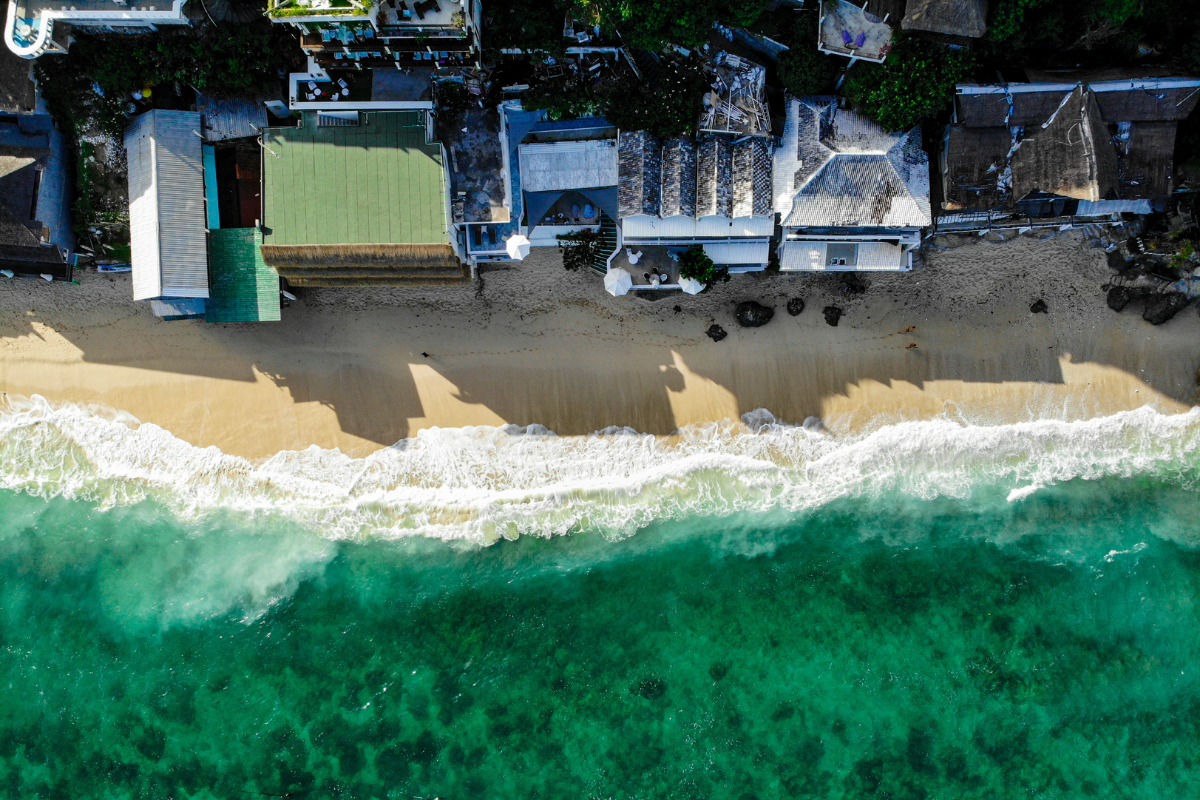
Bingin Beach looks different than it did two years ago. In July 2025, Badung Regency's government demolished more than 40 buildings along the cliffside — restaurants, shops and informal structures — citing spatial planning violations. The site sat cleared, mostly untouched, for close to a year.
That's not a rumour or a secondhand story. It's a documented government enforcement action, reported at the time and followed up on since, and it's directly relevant to anyone building or buying in the wider Bingin area — even though the demolished strip and the residential villa land further up the hill are not the same footprint or the same zoning history.
Losing 40-plus businesses in one action is a genuinely bad outcome for the people who ran them, whatever the legal basis for it. It's also true that the demolition itself was a lawful enforcement action — the structures didn't hold the approvals required for that stretch of coastline, and Badung Regency had the authority to act on it. Both things are true at once, and neither is really the point of this piece. The more interesting story is what's actually replacing what came down.
What's actually confirmed
The demolitions were carried out by the Badung Regency Government, with its Public Works and Spatial Planning Agency leading implementation. The stated basis was spatial planning violations — buildings that didn't conform to how that stretch of coastline is designated to be used. As of a January 2026 ground report, the area had settled into what's been described as a commercial vacuum: fewer visitors, fewer businesses, cleaner water and sand, and the same steep, narrow beach access that was there before.
What's planned now, per government sources: 2026 is largely planning and clearing. Physical construction on Phase 1 — basic infrastructure — is set to begin around the middle of the year: beach access improvements, clifftop stairs, water and utility networks, public facilities, and eventually wooden stalls and performance stages for future vendor use. Phase 2 is scheduled to begin in 2027, with full completion sitting beyond 2026 on current plans. In other words: by the time this piece is published, Phase 1 construction is either about to start or has just started, depending on how the schedule lands.
We're relaying what's been publicly reported here — by local press and by people who've actually gone and looked at the site — not something we've verified independently or have any special access to. Worth saying plainly, because it's easy for a fact like this to sound like insider knowledge when it's really just public record.
What's actually going in
Buried in that Phase 1 list is the detail that makes this worth paying attention to: a stage venue built specifically for Kecak dance and other traditional performances. Regent Wayan Adi Arnawa, announcing the plan, put it plainly: "We want Bingin Beach to become a new destination. We'll even create attractions like a venue for Kecak dance performances." That's not standard beach-access infrastructure. Stairs and a clean water network are what every redevelopment needs. A purpose-built cultural performance space is a choice, and it's not one we've seen attached to any other beach access project in the Bukit.
The budget behind it is IDR 20 billion, allocated specifically for this redevelopment. Alongside the stage: a temporary access road, public toilets, and the 3-metre-wide clifftop stairs already mentioned. The government also ran its planning process a little differently to how these things usually go — Arnawa says the design was socialised directly with Pecatu village residents before anything was finalised, and has framed community input publicly as central to what gets built, not an afterthought bolted on once the plan was set.
Put together, what's being proposed isn't just a rebuild of what was there. It's a government funding and designing a public cultural venue on a beach that, until last year, was entirely privately run — restaurants and warungs operating without the approvals that stretch of coast required, with no public infrastructure behind any of it. Whatever you think of how it got here, a formally planned, publicly funded beach precinct with a performance venue is a genuinely different model to how the rest of the Bukit's beaches operate, where development has mostly been private, ad hoc, and built out one lease at a time.
Why it's worth watching
None of this is finished, and a government infrastructure timeline slipping is not exactly a novel risk in Bali or anywhere else — Phase 1 was pencilled in for the middle of 2026, Phase 2 for 2027, and full completion sits somewhere beyond that on current plans. But even at the planning stage, this is a different kind of catalyst to the ones the Bukit usually gets. Most of what shapes demand in this area is private investment — a new beach club, a villa cluster, a road extension a developer funded to serve their own project. A council-funded cultural venue, built specifically to draw people to one stretch of coastline, is a different lever, and it's not one this part of the Bukit has had pulled before.
.jpg)
.jpg)
.jpg)